
The next day we got up whenever we managed to, and were already set to hit the road in search of a shop, when our old buddy Malak dropped by. He said we were going to his place for breakfast (along with the Aussie). Well, breakfast it is. The breakfast was modest: bread with hummus, and maybe a few veggies.
Then something weird happened. When we returned to William's Dead Sea Harmony Center (known to you from my words as the Couchsurfing shed), Malak asked if William had mentioned that lodging here costs money. Namely: 10 dinars per person. It's the first time I've encountered a Couchsurfer asking for money, so this demand totally blew my mind. Sasha and I didn't mind paying for the kind of cultural immersion we were treated to, complete with dinner and breakfast, but it was a bit weird to find out that all this Middle Eastern hospitality boiled down to a demand for dough.

A whole lot of pickup trucks, especially out in the sticks. Where people get the money for them is not really clear, but even those living in tents own cars like these
On the other hand, you can understand William — he's developing a non-profit, upgrading the shed with energy-saving bulbs, and adding new sections to it. It still left a bad taste in our mouths, but we didn't mourn for long; we packed our bags and rode off to look for a shop. It turned out to be two hundred meters away, and its selection suited us just fine. The only hassle was a bunch of clingy kids nearby who knew only two words in English: "Hello" and "Money-money". We ran into their colleagues many more times along the road, but in this region the kiddos were the most hardcore and annoying.

After stocking up on local sweets and chocolates, we headed to a nearby mobile phone shop, having decided to finally get a local SIM card, since I'd read that it was cheap and cheerful. Aussie Josh assured us that this was indeed the case, and for 7 dinars we'd get a gigabyte of data and a ton of calls/texts. The shop clerk didn't speak a word of English, so it took some time to explain what I wanted from him, especially since we had to pry the Latvian SIM card out of Sasha's tablet with a pocket knife. The clerk was too scared to do it, but Alexander himself pulled the operation off flawlessly.

I must say, nobody sweats English spelling in Jordan, not even the government, let alone private companies
About 15 minutes later, the process was successfully completed, though for some reason they charged us 10 dinars instead of 7, and the starter pack actually had the number "5" drawn on it. Whether it meant dinars or gigabytes remained a mystery (the Zain carrier's official website cleared up nothing). Well, compared to the prices for such cards somewhere in Italy, it's still humane, I reckon, but this wasn't the last time we were charged seemingly too much, because, being stupid tourists, we're incapable of grasping the real price. In all fairness, there were also plenty of times when they charged very little, and it even felt like they were helping us "for free", not caring how much we paid. Such are the paradoxes of the Middle Eastern mindset.
When I got back out on the street, Sasha told me he'd been laid siege to by the local kids, trying to figure out what the bottle on the bike was for. When he explained that it was for water, they snatched it, brought it back full, and started chanting their "Money, money" mantra all over again. To the locals' credit, the adults both in Al-Mazraa and other places constantly shooed them away so they wouldn't pester us.
Armed with our means of communication and nutritional substances in this manner, we rode to the turnoff from the Dead Sea to Karak and left the hospitable but trash-strewn village of Al-Mazraa behind.

Along the way we came across real fields of tomatoes (or peppers?)

Rybakov chugs down energy drinks, but to me their taste is so sweet-sour-disgusting that I make faces from a single drop


The country has loads of ancient trucks (from the 30s and later). Some of them, according to Sasha, are iconic all-wheel-drive Mercedes, but I forgot the model


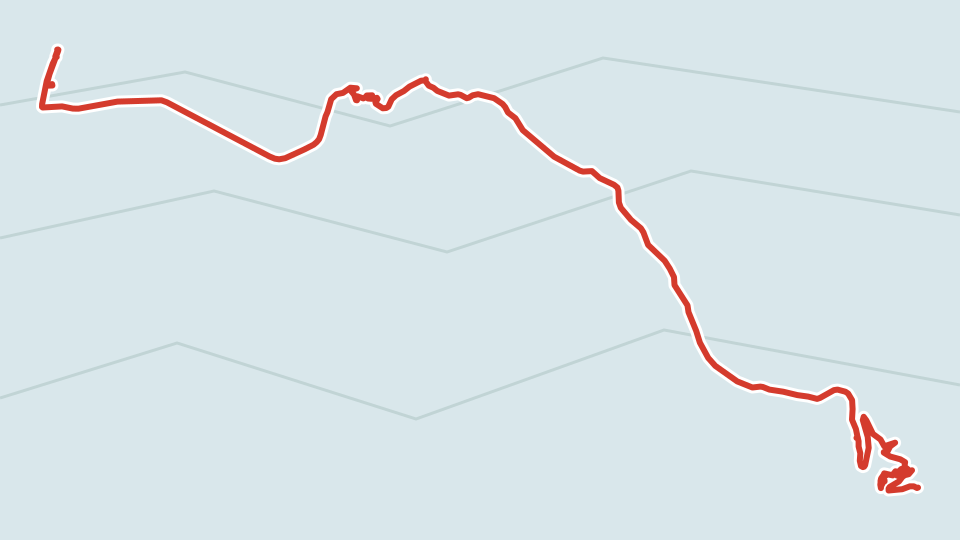
Next up was our already familiar routine: you pedal 100-200 meters uphill, rest, pedal, rest. Quite quickly we reached sea level, which looks roughly like this


A comical sign saying no photography allowed. What's to stop me from walking 10 meters down the road and taking a picture from there is beyond me.

Along the way, a little story happened that illustrates the local customs and ways. Near a flock of sheep, we were intercepted by some guys in camo, and I immediately tensed up because I'm not exactly fond of people in government service, but it turned out they were most likely just shepherds and wanted to offer us help and ask where we were from and where we were going. The fellas brought us some cooled-down tea, still loaded with an insane amount of sugar and sage, shot the breeze for a bit, and wished us a safe trip. Similar scenes happened to us time and time again. These encounters didn't evoke any strong fears or other negative emotions; on the contrary, they bolstered our confidence that the people here are good, and if needed, it would be easy to get help. The internet says that inviting a stranger (especially a foreign traveler) for tea is the most common thing in Jordan, and it's an easy way to make a bunch of contacts and find new friends.

When we climbed higher, a strong wind picked up, and it got noticeably colder

A boy was offering to give us a lift in Arabic, but we're proud birds and wanted to make it on our own, especially since there was barely any distance left


The little flower on the tree smells very nice, clearly some kind of spice

For lack of energy drinks in the village shop, Sasha is forced to drink 7-Up
While we were resting near some ruins on the side of the road, two rugged-looking fellas drove up and asked if we were Americans. Rybakov joked that the wrong answer could send us to the grave, but probably not. In general, for a Middle Eastern country relatively far removed from Europe, a surprisingly large number of people know at least one of the Baltic republics. Usually it's Lithuania or Estonia, but some also knew Latvia, which can't help but make you glad. The attitude, as I've already mentioned, always feels very good; I really don't know what it would be like if we had called ourselves Americans.

Closer to the city, curious graffiti started to appear

As you can see, by about four o'clock we made it to the city that formed around the Crusader castle. We got a bit lost in the narrow, crowded streets of its center, and realized that our hotel was located a hundred meters down from the castle hill. After a whole day of climbing, this basically meant that if we went down to the hotel, we wouldn't have the steam left to climb back up (especially in the dark). I started talking Rybakov into checking out the city and the ruins, and he eventually caved. At the end of the day, why travel to the ends of the earth just to sit in a hotel!
What exactly happened to us in Karak, whether it was a thrilling adventure or dreary wandering, you will find out in the next part.
P.S. Alexander is worried here that I haven't mentioned the local drivers' love for making noises with their horns. Every fifth, and sometimes every third car along the way honked at us — some for safety reasons, some to say hi, and some clearly out of a habit of honking at anything that moves.